Open four
Four consecutive stones of the same color have an empty point at each end.
If your opponent cannot win immediately, blocking one end still leaves the other end for you to complete five in a row.
Connecting your own stones is only part of the game: look for where your opponent can win, too. Compare Freestyle, Exact five and Renju, learn common patterns, then try them on the board.
These are the rules used in Gomoku Mate. Check which winning condition applies to your game before you start.
Black moves first on a 15×15 board, and players take turns placing one stone on an empty intersection. Only Renju forbids Black the double-three, double-four and overline. Renju · official opening adds the RIF regulation that keeps the first three stones near the center, White’s one chance to take Black, and a fifth move Black offers as two squares for White to pick from.
| Gomoku rules | Freestyle | Exact five | Renju |
|---|---|---|---|
| Five in a rowConnect exactly five stones of the same color horizontally, vertically, or diagonally, without a gap. | Wins | Wins | Wins |
| Six or more in a rowYou may make a longer line, but whether it wins depends on the ruleset. | Wins | This line alone does not win | Black loses, White wins |
| Double-three and double-fourThese moves create two open threes or two fours with a single stone. | Allowed for both colors | Allowed for both colors | Forbidden for Black |
First, check whether you can win on this move. If you cannot, stop your opponent's immediate win before building an attack. The patterns below use Freestyle rules.
Four consecutive stones of the same color have an empty point at each end.
If your opponent cannot win immediately, blocking one end still leaves the other end for you to complete five in a row.
Four consecutive stones of the same color have one end blocked by an opponent's stone or the board edge.
The remaining open end completes five, so check that point when attacking or defending.
Four stones of the same color occupy a five-point line with a single gap between them.
Filling that gap makes five in a row, so check gaps as well as continuous lines.
Practice winning immediately, blocking one point, making an open four, and filling a gap, then explore attacks in two directions and early defense. Each exercise has a goal and hints, with an explanation after you play.
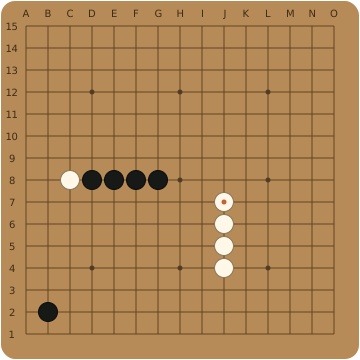
Your stones · Black
Start every turn by asking, “Can I win now?” If you can, there is no need to defend.
Before each move: your win → opponent's win → create an attack.
Open tactics practice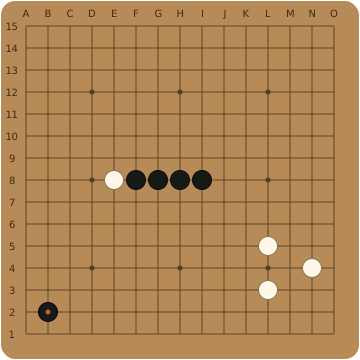
Your stones · White
If your opponent's four stones have only one open end, block that end.
Look beyond your own stones. Check your opponent's last move and open ends too.
Open tactics practice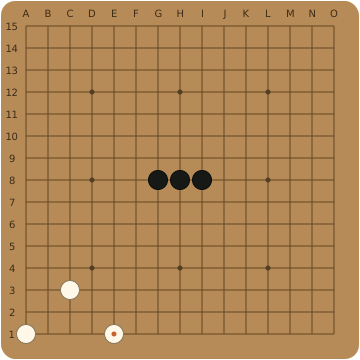
Your stones · Black
An open four has four consecutive stones with both ends empty. One move cannot block both ends.
Open space at both ends matters as much as the number of stones.
Open tactics practice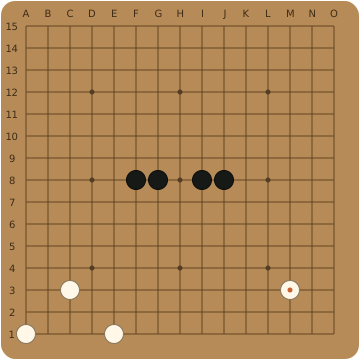
Your stones · Black
Four stones do not have to be consecutive to pose a threat. Check whether filling a gap would make five in a row.
Check both continuous lines and lines with a single gap.
Open tactics practice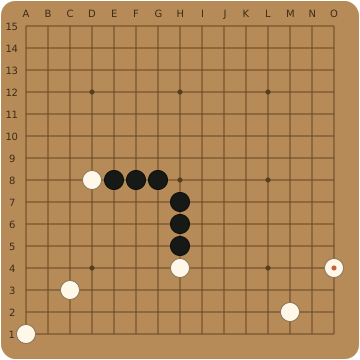
Your stones · Black
One stone can create a four in two directions. They must have different winning points to form two threats. This attack is legal in freestyle Gomoku.
Count distinct winning points, not just the number of threats.
Open tactics practice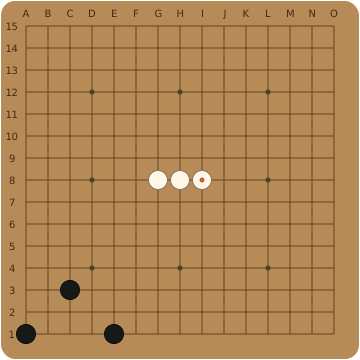
Your stones · Black
An open three can become an open four if left alone. Blocking a point one space away is sometimes not enough.
Plan your defense while it is still an open three, before your opponent makes a four.
Open tactics practice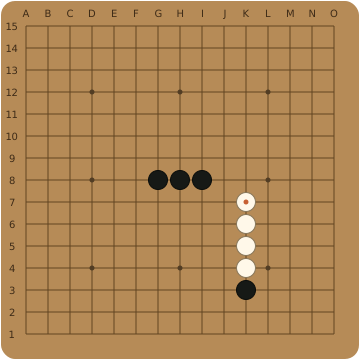
Your stones · Black
Even a strong open four is too late if your opponent can make five now. Move order determines the strength of a tactic.
Before asking “Is this a good attack?”, ask “Can my opponent win first?”
Open tactics practice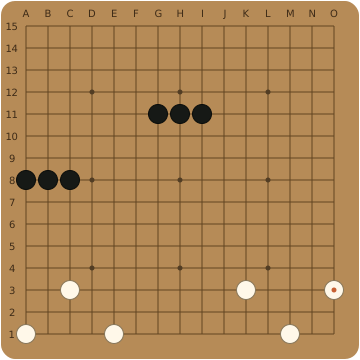
Your stones · Black
The edge of the board acts like a blocked end. Even with the same four stones, an open four in the center creates a stronger threat for the next move.
Edge attacks can be useful too, but first compare the room to extend in both directions.
Open tactics practice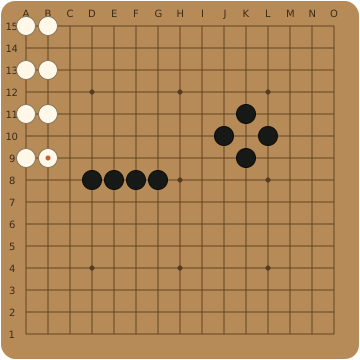
Your stones · Black
Renju forbids Black the double-three, double-four and overline. The more attractive the shape, the more often it is forbidden, so look for a line you can already complete before building an attack.
Strike forbidden squares off the list of candidates, and check the winning moves you already have first.
Open tactics practice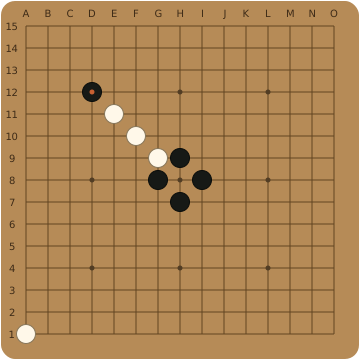
Your stones · White
White has no forbidden squares, and Black can never occupy its own. Build a four whose winning point is forbidden for Black and there is no block left.
In Renju, White can use Black's forbidden squares as places Black cannot defend. Leaving those squares empty is the same idea.
Open tactics practiceThe 8 tactics exercises and Coach help use Freestyle rules. In Exact five, a line of six or more does not count as a win, and in Renju Black may not play a double-three, double-four or overline. AI previews show possible continuations; they do not guarantee the best move or a win.